
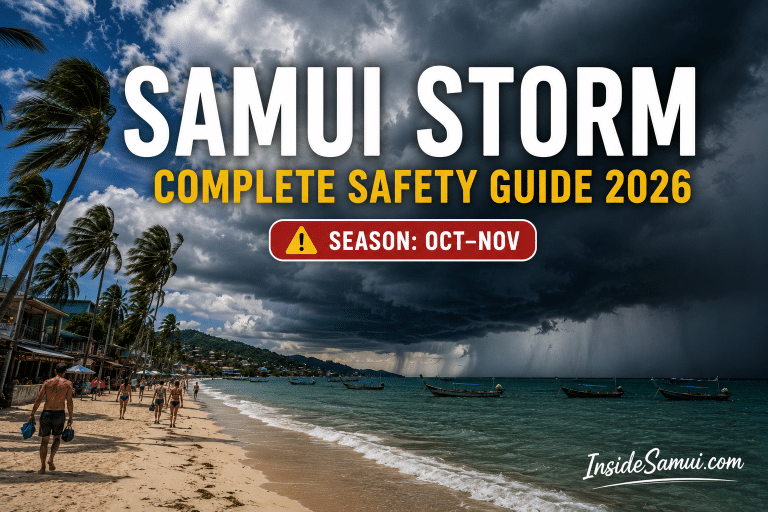
A Samui storm is one of the most dramatic weather events in the Gulf of Thailand — and understanding when they happen, how severe they can be and how to stay safe is essential knowledge for any visitor planning a trip to Koh Samui. The island's northeast monsoon season (October–November) brings the most significant Koh Samui storms, with tropical depressions occasionally intensifying into serious weather events that can affect transport, beach access and outdoor activities for several days at a time. This complete guide to Samui storms covers the full picture — when they happen, how to predict them, what to do during a storm and how to plan your visit to minimise the risk of encountering severe weather.
According to Thailand's Meteorological Department, Koh Samui averages 2–4 significant storm events per year — concentrated in October and November when the northeast monsoon interacts with warm Gulf of Thailand sea temperatures to produce the most intense weather of the island's annual cycle.
🏨 Book Koh Samui with Free Cancellation — Agoda →
Samui Storm — When Do They Happen?
| Month | Storm Risk | Frequency | Severity | Recommendation |
|---|---|---|---|---|
| January–April | ⭐ Very Low | Rare | Minor | ✅ Safe to visit |
| May–June | ⭐⭐ Low | Occasional showers | Minor | ✅ Generally safe |
| July–August | ⭐⭐⭐ Medium | Regular afternoon storms | Moderate | ⚠️ Plan around weather |
| September | ⭐⭐⭐⭐ High | Frequent | Moderate–Severe | ⚠️ Consider carefully |
| October | ⭐⭐⭐⭐⭐ Highest | Near-daily | Severe possible | ❌ Avoid if possible |
| November | ⭐⭐⭐⭐ High | Frequent (easing) | Moderate–Severe | ⚠️ Avoid early Nov |
| December | ⭐⭐ Low–Medium | Occasional | Minor | ✅ Generally safe |
October is statistically the most dangerous month for a Samui storm — the peak of the northeast monsoon when tropical depressions most frequently intensify over the Gulf of Thailand. The 2011 tropical storm caused significant flooding across Koh Samui. The 2017 storm caused ferry cancellations for over a week. If your travel dates fall in October, consider travel insurance with trip cancellation coverage and book fully refundable accommodation via Agoda.
Samui Storm — Types of Weather Events
Not all Samui storms are equal — understanding the different types of weather events helps assess the actual risk to your holiday:
| Type | Duration | Impact | Frequency | Season |
|---|---|---|---|---|
| Afternoon convective storm | 1–3h | Low · Heavy rain then clear | Daily in peak monsoon | Jul–Nov |
| Multi-day monsoon system | 2–5 days | Medium · Persistent rain · Rough seas | 2–4 per monsoon season | Sep–Nov |
| Tropical depression | 3–7 days | High · Heavy rain · Storm surge | 1–3 per year | Oct–Nov |
| Tropical storm (named) | Variable | Very High · Potential flooding | Rare · 1 per 3–5 years | Oct–Nov |
| Flash floods | Hours | High locally · Road closures | Occasional in monsoon | Oct–Nov |
Samui Storm — How to Monitor and Predict
The best tools for tracking Samui storm development and monitoring real-time conditions:
| Tool | Best For | Forecast Range | Link |
|---|---|---|---|
| Windy.com | Wind · Rain radar · Wave height · Best visual | 10 days | windy.com |
| TMD Thailand | Official warnings · Storm alerts · Local | 7 days | tmd.go.th |
| Joint Typhoon Warning Center | Tropical cyclone tracking · Named storms | 5 days | JTWC website |
| AccuWeather | Hour-by-hour rain · MinuteCast | 15 days | AccuWeather app |
| Weather.com | General overview · Rain probability | 15 days | Weather.com |
Windy.com is the most useful tool for monitoring Samui storm development — the animated radar overlay shows rain bands moving across the Gulf of Thailand in real time, wave height forecasts help assess sea conditions and the 10-day wind forecast gives advance warning of developing systems. Switch to the “Waves” layer to check sea state before booking boat trips.
Samui Storm — Safety Guide
If a Samui storm arrives during your holiday, here is the essential safety protocol:
During Heavy Rain and Thunder
- Leave the beach immediately — lightning strikes on open beaches are a genuine risk during tropical storms. Never shelter under a palm tree during lightning.
- Stay away from flood-prone areas — Koh Samui's interior roads and low-lying areas near streams can flood rapidly during heavy rain. Avoid driving scooters through flooded sections of road.
- Stay off scooters in heavy rain — wet road surfaces dramatically reduce traction. If caught in rain on a scooter, pull over and wait for it to pass rather than continuing through heavy downpour.
- Cancel boat trips proactively — if a developing Samui storm is forecast within 48 hours, cancel or postpone boat trips, snorkeling tours and ferries. Most operators cancel automatically, but initiating early prevents disappointment.
During a Sustained Tropical Depression or Storm
- Stay in your hotel or resort — luxury resort buildings are solidly constructed and the safest places to be during a serious storm event. The resort's emergency procedures are well-established.
- Stock essential supplies — water, snacks, phone charger, torch. Power outages are possible during significant storm events on Koh Samui.
- Monitor official warnings — follow TMD Thailand's official website and any alerts from Koh Samui's local government via Facebook (กาญจนดิษฐ์).
- Don't attempt ferry crossings in storm conditions — all reputable ferry operators (Lomprayah, Raja) cancel services when conditions are dangerous. Do not attempt to find an operator still running — the sea conditions that cancel ferries are genuinely dangerous.
Samui Storm — Historical Events
Understanding past significant Samui storm events provides context for the real risk level:
| Event | Date | Impact | Duration |
|---|---|---|---|
| Tropical Storm Harriet (1962) | October 1962 | Severe · Significant loss of life on mainland | Several days |
| 2011 Tropical Depression | November 2011 | Severe flooding · Road closures · Airport disruption | 5–7 days |
| 2017 Storm System | October 2017 | Ferry cancellations 7+ days · Beach damage | 1 week |
| Annual monsoon events | Oct–Nov each year | Moderate · Disruption to boats · Flooding possible | 2–5 days each |
It is important to note that significant Samui storm events — those that cause serious damage and disruption — are relatively rare. Most monsoon seasons pass with temporary disruption rather than catastrophic events. The risk is real but should be understood in context: Koh Samui receives millions of visitors annually and the vast majority experience no storm-related issues.
Samui Storm — Impact on Activities
| Activity | Afternoon Storm | Multi-Day System | Tropical Depression |
|---|---|---|---|
| Beach swimming | ⚠️ Pause 1–2h | ❌ Rough seas | ❌ Dangerous |
| Boat trips / Ang Thong | ⚠️ Check morning | ❌ Most cancel | ❌ All cancel |
| Ferries (Koh Phangan/Tao) | ✅ Usually run | ⚠️ Delays possible | ❌ Cancelled |
| Scooter ring road | ⚠️ Wet roads | ❌ Flooding risk | ❌ Dangerous |
| Restaurants · Nightlife | ✅ Open | ✅ Mostly open | ⚠️ Some close |
| Spa · Indoor activities | ✅ Perfect storm day | ✅ Perfect | ✅ Stay in resort |
| Temples · Sightseeing | ⚠️ Rain gear needed | ⚠️ Possible with care | ❌ Stay in |
| Night markets | ✅ Usually open | ⚠️ Some close | ❌ Close |
Samui Storm — What to Do During a Storm
A Samui storm day at the resort doesn't have to be a wasted day — the island's indoor and resort-based options are genuinely excellent:
| Activity | Storm-Proof | Cost | Where |
|---|---|---|---|
| Thai massage / Spa day | ✅ Fully indoor | 300–6,000 THB | Resort spa · Local spa |
| Thai cooking class | ✅ Fully indoor | 1,200–2,000 THB | Island-wide |
| Yoga class | ✅ Fully indoor | 300–800 THB | Resort · Studios |
| Gym · Fitness | ✅ Fully indoor | Included at most resorts | Your resort |
| Resort pool (no lightning) | ✅ Between storms | Included | Your resort |
| In-villa dining | ✅ Perfect storm day | Resort menu | Your villa |
| Movie / reading day | ✅ Perfect | Free | Your room |
Samui Storm — Booking Strategy
The most important financial protection against a Samui storm disrupting your holiday is the right booking strategy:
- Always book free cancellation accommodation — if you are visiting during September–November, free cancellation via Agoda is non-negotiable. A significant storm event can ground flights, cancel ferries and make the entire trip unviable. Refundable hotel rates protect your investment.
- Book activities with free cancellation — all GetYourGuide boat trips and tours offer free cancellation up to 24 hours before departure. This is essential during storm season — operators cancel when conditions are unsafe and you need full refund protection.
- Consider travel insurance — travel insurance with trip cancellation and disruption coverage is strongly recommended for October–November visits. A tropical storm event can result in significant unrecoverable costs without insurance.
- Monitor forecasts from one week out — use Windy.com and TMD Thailand to track developing systems from 7 days before your departure. Significant storm events are usually visible in forecast models 5–7 days ahead.
- Have a plan B — if a serious storm is forecast during your planned visit, know in advance that you could pivot to Bangkok, Chiang Mai or the Andaman coast (which has its best weather when Koh Samui is at its worst in October).
🏨 Book with Free Cancellation — Agoda →
FAQ — Samui Storm
When is storm season on Koh Samui?
The Samui storm season runs from October to November — the northeast monsoon peak when tropical depressions most frequently develop over the Gulf of Thailand. October is the highest-risk month statistically. September sees increasing storm frequency as the pre-monsoon transition progresses. December to April is the driest and least stormy period — the safest time to visit.
How dangerous are Koh Samui storms?
Most Samui storms are inconvenient rather than dangerous — heavy rain, rough seas, cancelled boat trips and some localised flooding. Significant tropical depressions and named storms (which occur every few years) can cause more serious disruption including flight delays, airport closure and flooding. Following TMD warnings and staying at your resort during serious events is the appropriate safety response.
What happens to ferries during a Samui storm?
Ferry operators on Koh Samui — Lomprayah and Raja Ferry — cancel services when sea conditions exceed safe operating thresholds. During a significant Samui storm this can mean 2–7 days of no ferry service between Koh Samui, Koh Phangan and Koh Tao. If you have onward travel connecting to a ferry, book fully refundable tickets via 12Go Asia and have alternative plans.
Should I cancel my Koh Samui trip if a storm is forecast?
A single tropical storm forecast does not necessarily mean cancelling your entire trip — most Samui storm events pass within 2–5 days and are followed by normal weather. If you have booked free cancellation accommodation and activities, you have flexibility to adjust day by day. For serious multi-day storm events (tropical depression or above), pivoting your itinerary to Bangkok or the Andaman coast may make sense.
Continue Reading
- Season Samui — Best Time to Visit
- Koh Samui Weather April 2026
- Koh Samui Weather July 2026
- Complete Guide to Koh Samui 2026
- Scooter Rental Koh Samui
Some links are affiliate links. InsideSamui.com earns a commission via Agoda and GetYourGuide at no extra cost to you. Storm data based on TMD historical records. Updated 2026.